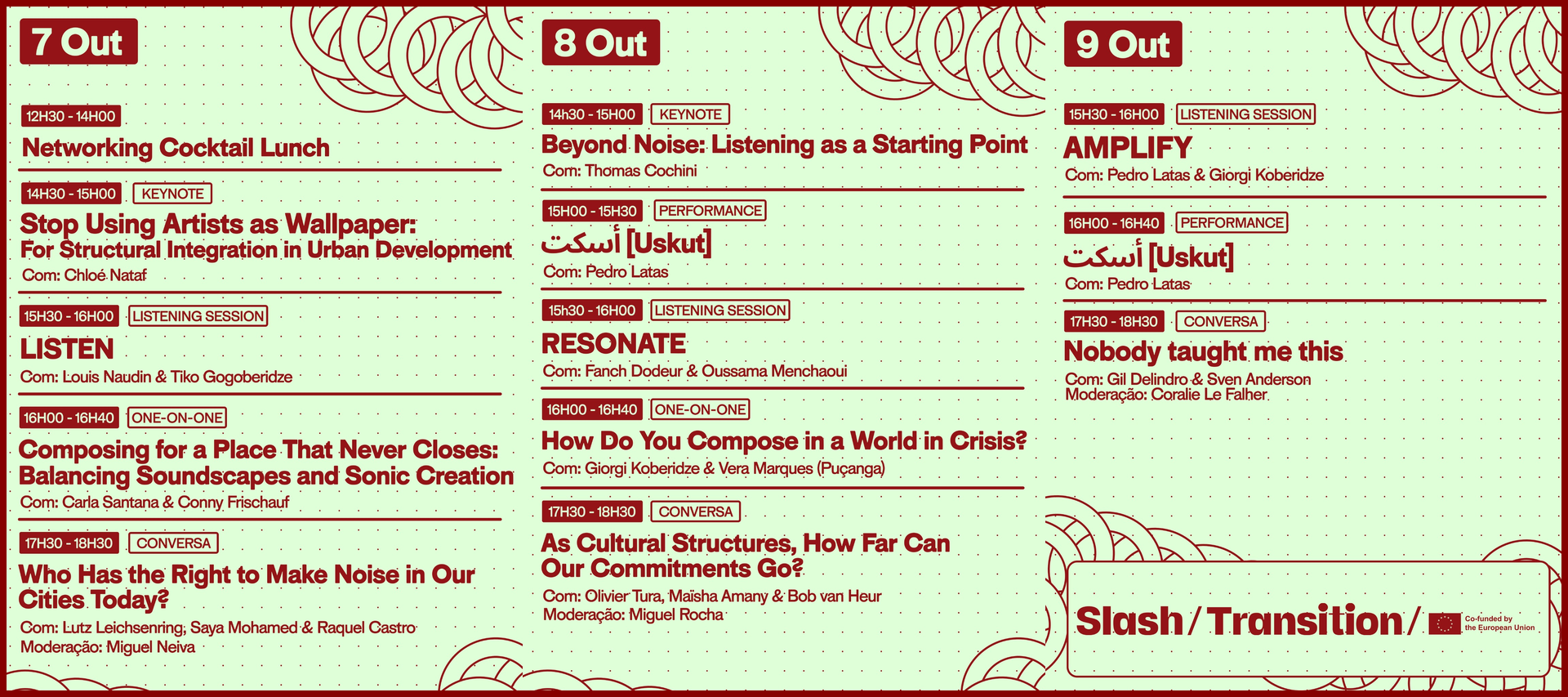
Three days before her departure for Lisbon, we spoke with Chloé Nataf, Slash Transition coordinator at Trempo, about the programme of this final chapter of the project, taking place from 7 to 9 October.
From bringing together the ten sound works produced throughout the four-year project to exploring the role of sound in urban, social and ecological transformation, she tells us more about what to expect from this final gathering and what it means for Slash Transition.
Detailed programme available on MIL’s instagram and website.
Hi Chloé! Can you tell us about these two weeks in Lisbon?
We’re going to Lisbon for the final event of Slash Transition, which marks the end of four years of experimentation. Since the beginning of the project, we’ve tried to optimise travel abroad as much as possible. This two-week mobility, particularly for the artists, allows us to combine creative time, meetings and dissemination activities.
How these two weeks will unfold?
The public event will run for three days, from 7 to 9 October, alongside the MIL Festival. There will be an exhibition open throughout the three days, as well as a programme of keynotes, panels and other formats for exchange. The exhibition will bring together the ten sound works produced over the past four years by ten artists from Georgia, Tunisia, Portugal, Austria and France.
Before this Final Convention, we’ll also bring together everyone who has been involved in Slash for a gathering we call the “Collab Lab”. It will be three days of collective intelligence sessions with two main objectives: looking back at what has happened over the past four years, but also thinking about what a future Slash Transition could look like — potentially a more ambitious version, with more partners and a stronger presence across different territories.
And even before that, we’ll be reunited with many of the Slash Transition artists for a creative sound workshop, as part of their post-coaching programme. We’ve given them a brief: they have to produce at least fifteen minutes of sound work around a theme connected to the Beato area, where Casa Capitão is located. They’ll be experimenting with sound, doing field recordings, working with storytelling, and so on. We’ll support them throughout the creative process, and the resulting works will then be available to listen to during the Final Convention.
When you say the sound works will be available to listen to, what exactly do you mean?
When we developed the programme with Catarina Branco from Casa Capitão, it was important to put listening back at the centre of the keynotes, panels and other formats. So we won’t physically add new works to the exhibition. Instead, we’ll offer headphone listening sessions around the new creations, with one work presented each day and no commentary: the idea is for the sound to speak for itself.
Could you explain how you developed the programme and its themes?
It responds to several objectives that are inherent to the final convention of a European project, and more specifically to Slash Transition.
There will inevitably be a dimension of reflection and review, looking back at what happened throughout the project. That’s why some Slash Transition artists will be taking part, but they won’t be the only ones. We also want to open up a discussion around sound as a vehicle for urban, social and ecological transformation, among other things. We’ve structured the three days of the convention around the themes LISTEN, RESONATE and AMPLIFY.
We tried to offer a range of different formats. Each afternoon starts with a keynote that sets the scene for the day’s theme, almost like a political programme, lasting around twenty to thirty minutes.
This is followed by a listening session connected to the theme, and then a conversation between two artists, with a more artistic focus centred on their position or creative process. The idea is almost to hear them as if we were sitting in their living room, talking about their practice from a particular perspective.
Finally, each day ends with a panel lasting around an hour, with a more institutional focus, looking at how organisations can support these emerging practices and take sound and sound artists into account when shaping territories.
Can you tell us more about the venue where the Convention will take place, and the neighbourhood it is part of?
The Final Convention is taking place at the same time as the MIL festival, at the same venue. It is organised and produced by Casa Capitão, which also organises MIL and opened the venue around a year ago.
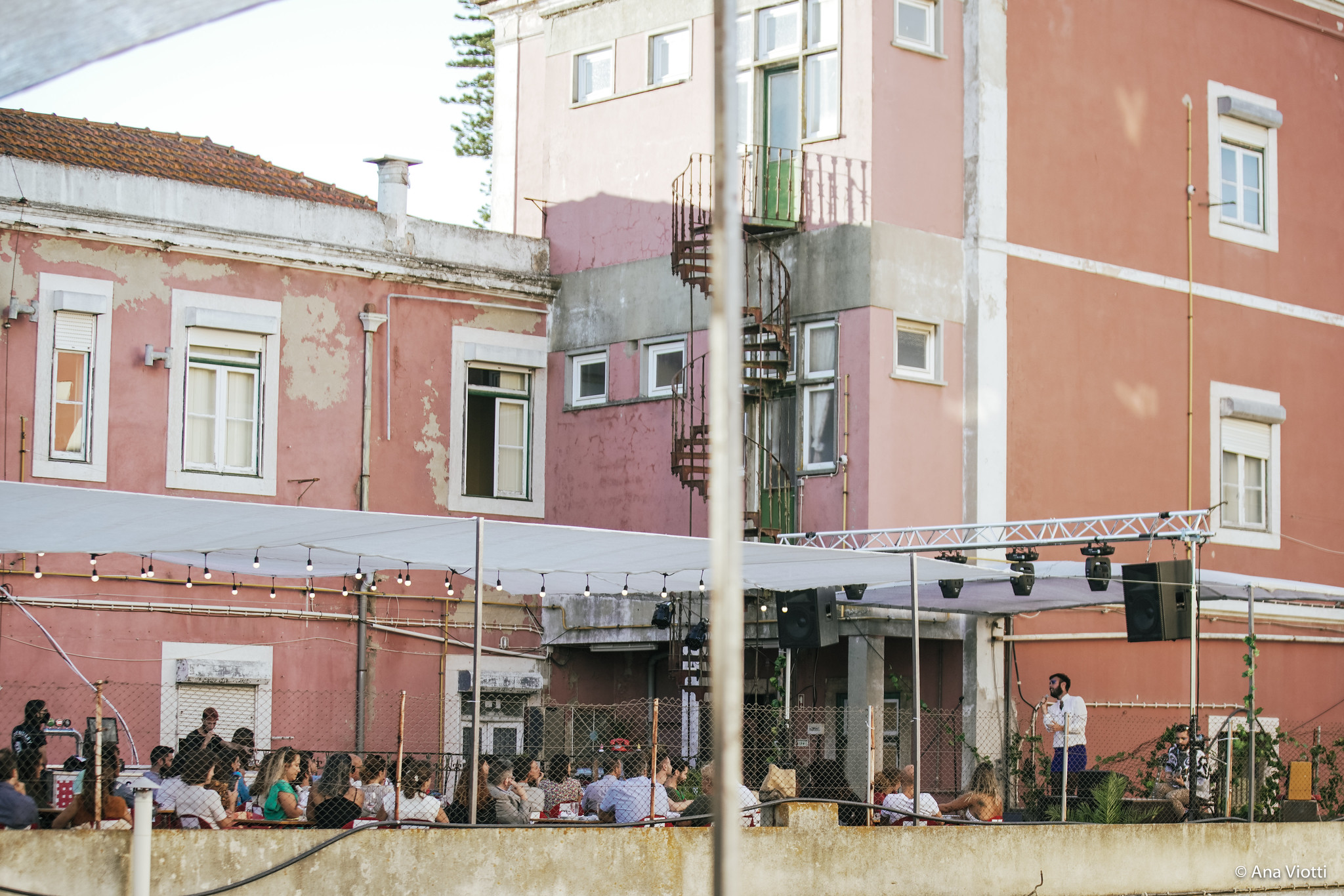
The site is located on a former industrial site, including an old bread factory, and now brings together several different structures: Casa Capitão, with a concert venue, a terrace and restaurants, as well as a school, a brewery, coworking spaces and other activities.
The Convention will take place in two buildings that have seen little redevelopment. They were once part of the industrial process of turning wheat into flour and then producing bread. The site’s still very raw, almost abandoned character strongly resonates with the themes of Slash Transition, particularly around urban transitions.
The site is located in Beato, a neighbourhood that has historically been quite working-class and remains so today. This raises a question that we don’t necessarily have an answer to yet: what role can we, as a cultural organisation, play in the gentrification of a neighbourhood?
The artistic commissions developed with Casa Capitão are precisely conceived from this territory. The artists are invited to work around the Beato neighbourhood, its memory and its architectural heritage. They are asked to make recordings of the neighbourhood and work from this material.
What makes this Convention such an important moment for the project?
A public final event is important for several reasons. We’re especially looking forward to having everyone together again: artists, partners and local facilitators. We had already seen some of the participants in Nantes in December, and another group in Tunis in February 2025, but this time, everyone will really be there. It will also give the artists from the different cycles a chance to meet one another.
Having all ten works together in the same place will be valuable too. We might be able to identify connections between them that we hadn’t noticed before, and see how they speak to one another. I also realised that the works can be influenced in different ways depending on the programme and the context in which they’re presented. Bringing them together like this might allow us to observe that more closely.
And having everyone there means we’ll be able to gather feedback and present the project and the works to a wider audience, including professional and institutional audiences: urban planners, people from the music industry, and music ecosystems from Portugal, Spain, Brazil and Europe more broadly.
So it will be a reunion, but also, in a way, a goodbye, since we probably won’t all see each other again before the project officially ends on 28 February 2027.
Is there anything in particular you’re looking forward to about this moment?
Yes. I simply can’t wait to be there. When you’ve been working on an event for this long, you eventually start counting down the days.
And above all, I’m really looking forward to seeing the artists meet one another.