Pacôme Soissons, architect and artist behind Bureau des Hypothèses develops projects that move between research, fiction, urban memory, and public space. Through temporary interventions, collective actions, and speculative narratives, his practice explores overlooked territories and asks how imagination can reshape the way we relate to cities.
In this conversation, we discuss uncertainty, collaboration, experimentation, and the possibility of rethinking architectural practice through stories, fragile gestures, and long-term engagement with place.
You recently moved back to Dunkirk after years working in Brussels. Could you tell me a little about that transition and how Bureau des Hypothèses emerged?
I live between Dunkirk, in the north of France, and Switzerland, where my partner lives. I came back to Dunkirk around three and a half years ago to finally give myself the time to really develop the research around Bureau des Hypothèses. For years it existed more like a fantasy in my mind.
Before that, I worked for almost eight years in Brussels as an architect, mainly on construction sites and public infrastructure projects, especially in the cultural field. Later I also worked on smaller private architectural projects. I was always interested in research, but not really in the academic world. Maybe because I found it intimidating, but also because I wanted theory and practice to exist together.
The name Bureau des Hypothèses already suggests that not everything needs to be solved or resolved. What first led you toward hypotheses instead of answers?
At first, it came from wanting to move away from architecture’s traditional posture. Architects are often expected to provide solutions. I became uncomfortable with that position, especially in relation to climate change, social transformations, and the instability of contemporary conditions. I felt architecture was too often about being right rather than experimenting.
The first version of Bureau des Hypothèses emerged while writing a residency proposal with Pauline Delwaulle, a friend who is a visual artist. We spent a week in Paris trying to imagine a protocol of work that wouldn’t be based on expertise or certainty. Instead of saying, “We know this field and we will solve things,” we imagined an office open to experimentation, a place where architecture, art, research, intuition, memory, and observation could coexist. At the same time, the project was always deeply connected to Dunkirk itself. It wasn’t an abstract speculative exercise. Dunkirk is an intense industrial territory marked by harbour infrastructures, unemployment, economic shifts, colonial histories, and complex social narratives.
For years the city carried this negative image — “the north,” unemployment, industrial decline. So the idea became: how can we create hypotheses that are rooted in memory and heritage, but also project something into the future? How can we move beyond nostalgia and create possible projections?
Your work suggests that uncertainty itself can become productive. How does that uncertainty shape the way you approach places and situations?
Maybe the important thing is not that nothing needs to be resolved, but that we can be interested in everything.
In France, we love categories and labels. Everything is separated into disciplines. Architecture, art, research, science and each has its own territory. But I think there is a strong need for interdisciplinarity nowadays.
At first there was uncertainty around what Bureau des Hypothèses even was. Architecture? Art? Research? I didn’t know. But by refusing labels, the work started moving in directions I couldn’t have predicted. That uncertainty became productive. And at the same time, I wasn’t comfortable with architecture’s solution — based approach, but I was also not fully comfortable with art practices that only raise questions without proposing anything tangible. So I became interested in provisional or precarious solutions — sometimes it’s an installation, a line of trees, a carpet, a light intervention. The object itself matters less than the dialogue space it creates around it.
You don’t arrive with a final answer. You create conditions for collective discussion and long-term engagement.
Many of your projects take place in overlooked or transitional spaces. What draws you toward certain sites?
I don’t really choose sites. They come to me. That sounds a bit mystical, but it mostly comes from years of observation, usually while cycling through the territory. The bicycle gives you the right rhythm. You’re slow enough to observe, but still moving through space.
What interests me are what I call “figures” of the territory — places that carry memory or heritage but have become forgotten, neglected, or invisible. Sometimes it’s linked to industrial history or colonial trade routes. Sometimes it’s simply a shape in the landscape. For example, I became fascinated by lines of trees along canals. In Dunkirk’s flat landscape, these lines create perspective, rhythm, shadows, vertical presence in the landscape. They structure the territory.
Another project started simply because I was attracted to the curved shape of a small abandoned pavilion. At first it was purely formal fascination. Only later did the historical and narrative layers emerge.
I’m also interested in places that people hate or want to erase. I like the idea that new narratives can emerge around neglected spaces instead of simply destroying them.
In Bureau des Hypothèses, speculation becomes collective. How do you create conditions for others to participate without flattening differences in perspective?
That’s maybe one of the most complicated parts. Bureau des Hypothèses is not a romantic collective where people from different fields gather in a studio and create together all the time. It’s much more obsessive and personal than that.
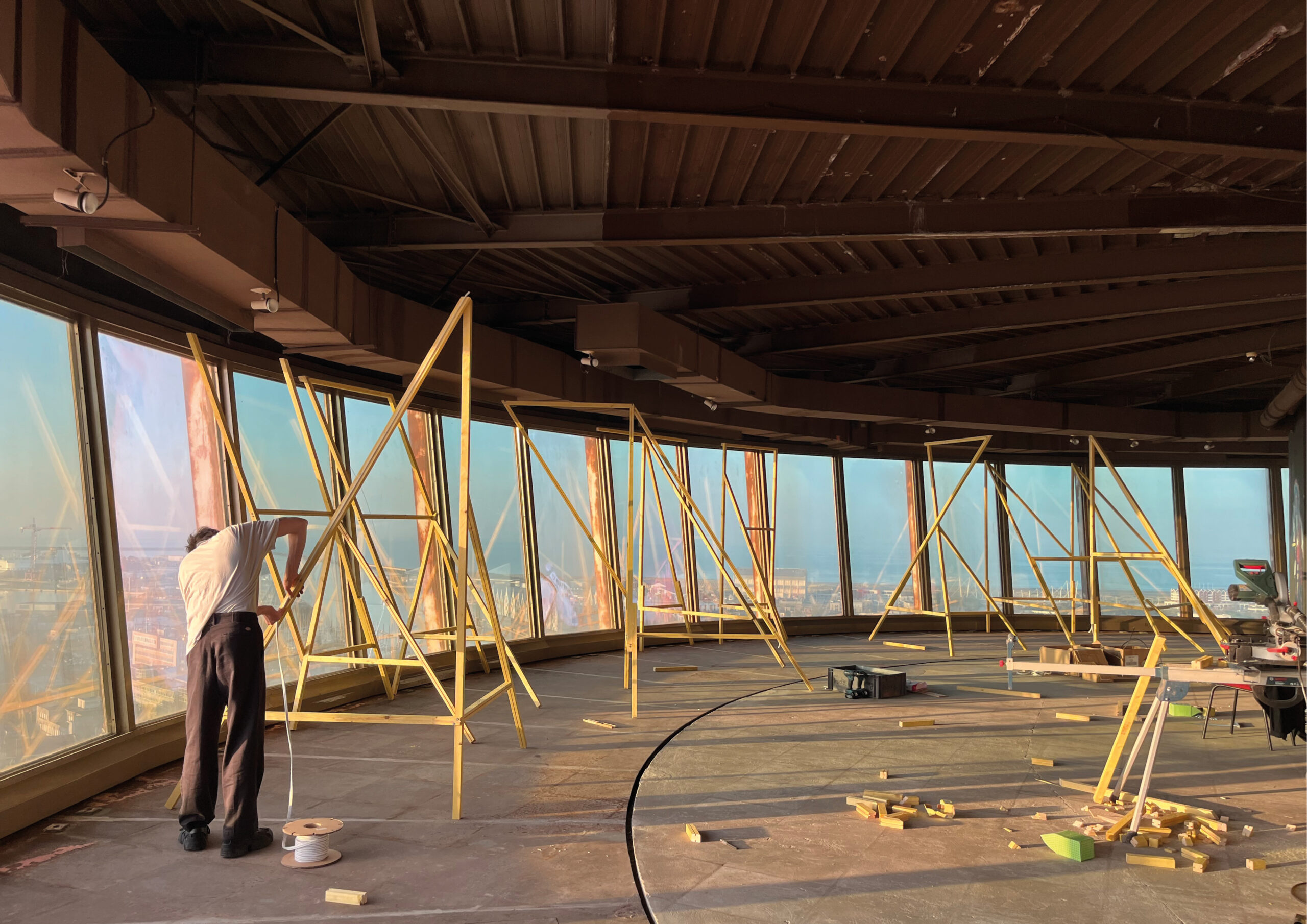
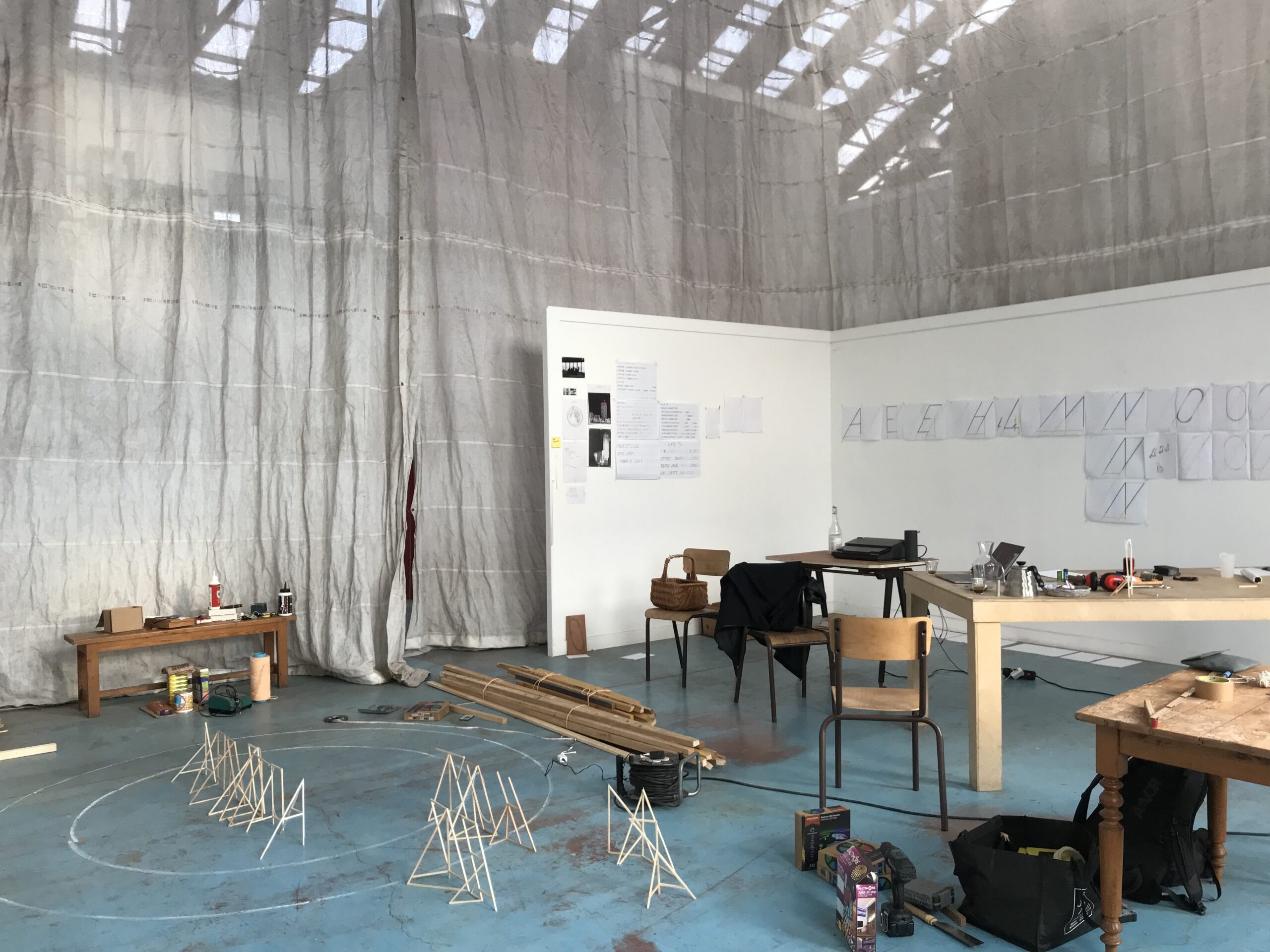
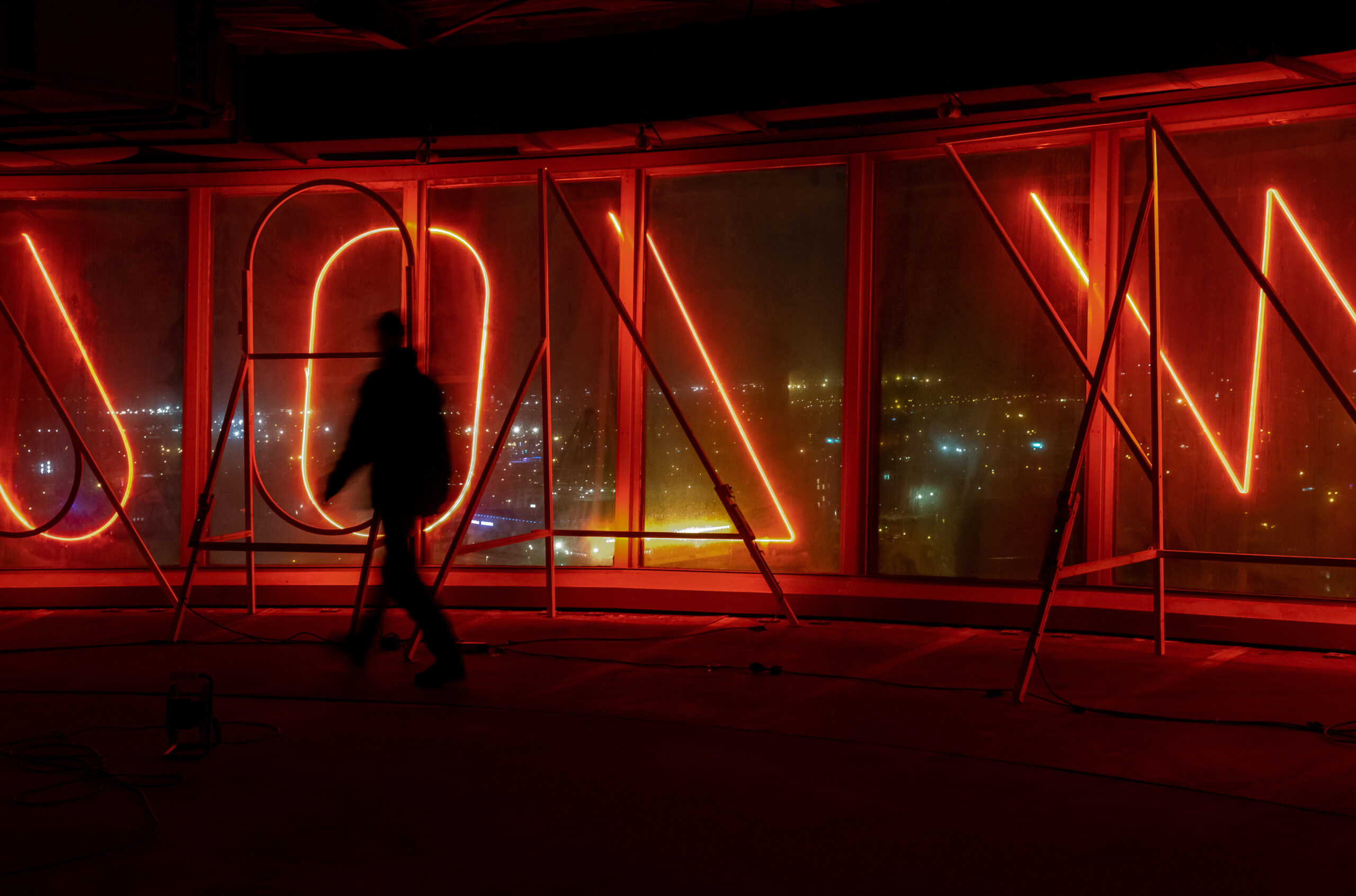
I work a lot with Elisabeth Gueuret, a retired sociologist who has spent her entire life in Dunkirk. She has a deep knowledge of harbour workers’ memories and local history. At the same time, I was always uncomfortable asking people to join my obsessions without any structure or compensation. So usually the process begins with research and small experiments. Then, once I find funding or permissions, I can invite collaborators properly. Sometimes collaboration is very concrete. For the illuminated letters project on the tower, I worked with Tristan Bartolini, an artist based in Geneva whose typographic work had caught my interest – we built prototypes together, tested materials, and eventually ended up collaborating on the entire design and construction of the letter structures.
Other times, collaboration happens through conversations, archives, or informal exchanges. Someone working in the city archives sends me documents. Someone else shares memories of a building. These small contributions become part of the work.
What matters is building trust slowly enough that people eventually enter the speculative space with you.
Narrative seems central to your practice. Stories, possible futures, fictional projections. how do you balance imagination with reality?
At the beginning, I didn’t trust my own ideas. I would think about something and immediately tell myself it was too unrealistic or too strange. For a long time I minimised my own projects by calling them jokes.
The tower project started like that. I kept saying, “It’s just a joke.” But eventually it became reality because I spent years insisting on it. Nobody ever told me, “Amazing idea, go for it.” It was constant work — convincing people, rewriting, visualising, explaining. So for me, imagination only becomes reality through an iterative process. Everything starts as text. I write a narrative first. Then I share it with people. If people respond to it, the narrative slowly becomes tangible.
I also try to keep the language accessible. At first my writing was extremely architectural or trying to be academic. It was boring, even for me. Later I realised humour was important. Humour, memories, jokes, serious references — all these things can coexist. And what’s interesting is that as soon as you focus on places, people immediately connect. Everyone has memories linked to territories. Someone worked there. Someone passed by that building every day. Someone remembers what used to exist there. So even if the project starts from imagination, people quickly bring their own realities into it.
Your practice often moves between architecture and art. Do you see it as a critique of traditional architecture, or as an attempt to reconfigure what architectural practice can be today?
I wouldn’t say I’m trying to completely reconfigure architecture. That would be too ambitious. But I do think it’s important to show that other paths exist. My critique is not directed at architecture itself. I actually love architecture. The problem is more about the conditions in which architecture operates today. Either you work in offices where burnout becomes normal, or you work on private projects disconnected from public questions.
Architecture competitions create extremely competitive environments where experimentation becomes difficult. Young architects are under pressure to succeed immediately. There is very little space for failure.
What interested me was finding ways to experiment outside those structures — especially in non-metropolitan contexts like Dunkirk. I realised speculation only becomes meaningful when it interacts with real places, inhabitants, institutions, and political structures. Today, I think speculation needs to become local and situated. That’s why I’m interested in bringing speculative thinking into very concrete territorial situations.
You once spoke about the distinction between the “provisional” and the “precarious.” Could you explain that?
Yes, during a roundtable with Tamaya Sapey Triomphe, she quoted this theoretical difference between provisional projects as things designed to disappear from the beginning, while precarious things actually want to stay. I immediately recognised myself more in precariousness than in provisionality.
A lot of temporary urbanism today becomes instrumentalised by real-estate strategies or institutional communication. Temporary interventions, participatory installations, sometimes they are interesting, but they are also often designed to vanish. I became sceptical of that. For example, one of my projects involved planting a line of fifty-one trees along a canal. It’s an extremely simple gesture. Maybe some trees will die because of climate change. Maybe the landscape will transform. But the project still projects itself into the future.
If I could make projects more permanent, I probably would. At the same time, some interventions are too exposed or too personal to remain forever. The illuminated tower, for example, was so present in the city that eventually I was relieved when it ended. So permanence and disappearance are always negotiated.
Your references move between philosophy, architecture, storytelling, and social practice. What kinds of influences shaped your thinking most strongly?
I read fragments, ideas, chapters. Sometimes a text suddenly resonates with questions I already have. Reading Isabelle Stengers was important for me, especially her thinking around speculative narratives and situated realities. What interested me was this idea that fiction does not need to be abstract. A narrative can remain extremely close to reality while still opening possibilities. That also helped me trust non-academic forms of thinking.
Sometimes we create unnecessary restrictions for ourselves because we believe we need institutional legitimacy before speaking. But sometimes reading three pages that genuinely affect the way you think can already change your practice.
I also remember this discussion Leila Haghighat during a roundtable where she said that all these complicated discourses around space or art scenes sometimes hide something extremely simple: people just want places where they can meet, talk, and encounter each other. That simplicity stayed with me.
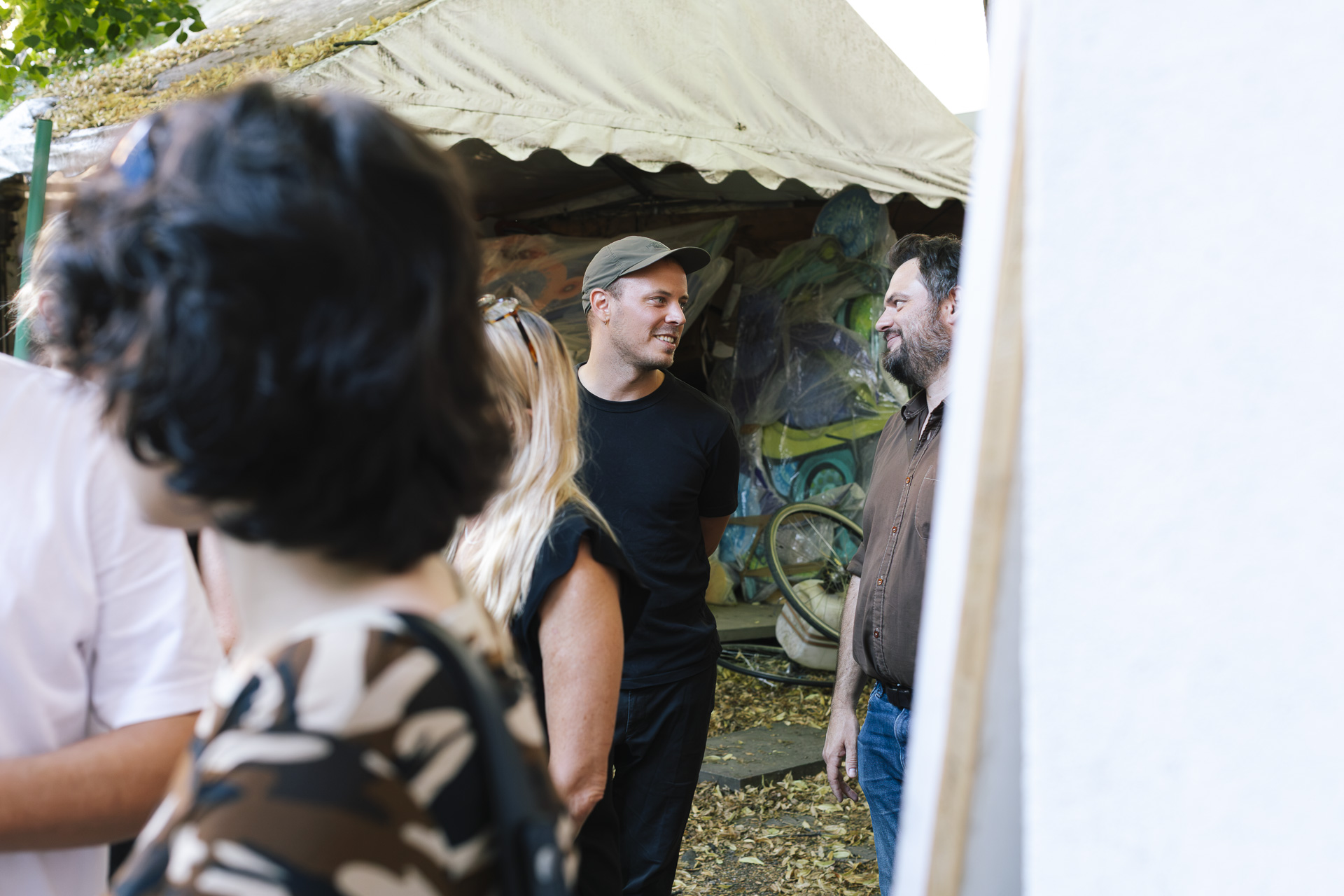
Pacôme and Ben Wheeler from Mutant Radio during Überkeine’s residency in Innsbruck in July 2026 © Aslan Kudrnofsky
What do you hope remains after your projects end?
That’s difficult, because I still struggle to let projects go. The architect in me always wants things to continue. For example, after organising a small festival inside a pavilion, I immediately started negotiating with the mayor to see if the building could eventually be renovated.
Sometimes I think maybe I go too deep into these obsessions. But as long as a place remains uncertain, neglected, or absent from public narratives, I feel the need to continue working on it.
At the same time, I’m learning that what remains does not always need to be physical. It can be texts, archives, publications, images, traces, memories. Right now I’m working on a compilation of texts — around thirty-six chapters connected to the territory — trying to give form to the narrative dimension of the projects.
In small cities, being perceived as an architect often gives you more legitimacy than being perceived as an artist. So I constantly move between these identities. But maybe that instability is also part of the practice itself.
At one point during our conversation, you mentioned that you often don’t trust your own ideas. Yet your projects are deeply ambitious. How do you continue despite that doubt?
I think the whole practice is really about finding ways to continue despite doubt. I often imagine projects as constellations — many small interventions, places, gestures, conversations, all connected together.
I’m good at imagining the constellation. What’s harder is taking things step by step. But through experimentation, through small actions, you slowly gain trust. You try something. It works or it fails. Then you try again. That’s the beauty of experimental practice. You accept that uncertainty is part of the process.
And maybe that’s also what Bureau des Hypothèses ultimately is: not a search for definitive answers, but a continuous attempt to keep imagination active inside reality.
Interview: Keti Davitashvili