by Tamar Babuadze
November, 2025


07 January 2026
Following the Bien Urbaines paper (published on April 9, 2025), we invited different people to give us their thought on "hospitality". You can find Kitti Baracsi's ecopoetic glossary on the "Ressources" tab of this website for instance. Today, Tamar Babuadze is sharing with us a conversation that happened with herself from several solo walks in Tbilisi, Georgia.
Hospitality in times of crises: confessions of an amateur guide
by Tamar Babuadze
November, 2025
It is a little after 9 am, a warm October morning. I step off the bus and rush past the Galeria Tbilisi shopping mall, then I float by the 19th-century City Hall building. The sun spills over the neatly lined grand plane trees, casting a golden hue reminding me of the color and sweetness of acacia honey.
Here I am on the downhill of Kote Abhkhazi street.
Kote Abhkhazi was a military figure and politician, one of the leaders of the underground national-liberation movement against the Bolshevik government; he was executed in 1923 by the security police for plotting the anti-Soviet uprising. – I find myself automatically reciting a line from my ‘guide’s speech,’ a rehearsed monologue of mine.
“You are in a good shape, Tamar”, – I tell myself amused a bit. It’s as if I’m walking on a thermal interactive map: as I approach my ‘field’, the past ignites within me arisen simultaneously from the material setting. In just two days, I’ll lead my first food tour in a long while, and I am back to revisit my usual route, to rehearse and to reactivate a mindset of hosting.
Excitement channels through me as the narrative of old Tbilisi effortlessly reenters my mind. The past resurfaces as soon as my body physically engages with the spatial dimension of Tbilisi. Each step draws me closer to uncovering layers of history intertwined with the sensation of ‘here and now’ – a very complex entity itself. Their simultaneous reactivation triggers me to produce a mental collage of the Tbilisi story; Togetherness of the past and the present electrically charges me with emotions and necessary language to retell Tbilisi.
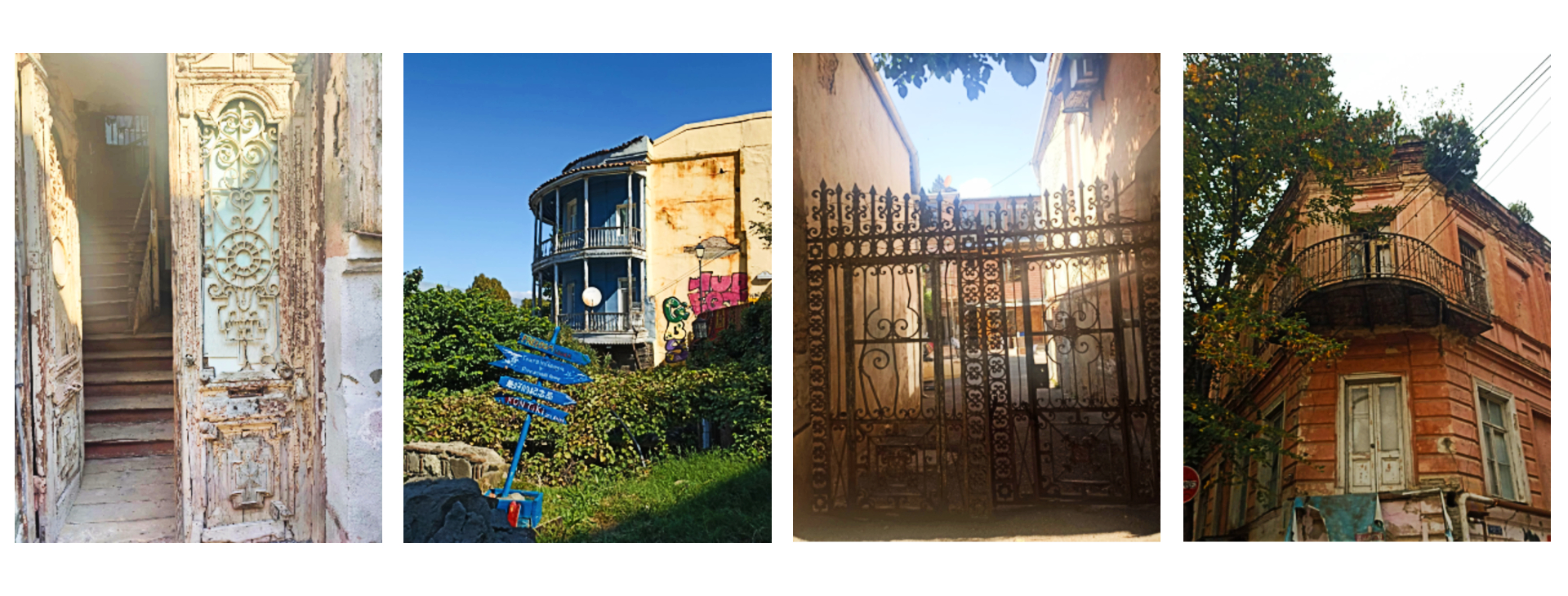
Capturing literal multi-layering characters of Old Tbilisi. Photos by the author from 2024-25.
That’s when I uncover a very complex position of a host: walking in the present dimension of this particular neighborhood – already contested with gentrification and other social and political challenges – while forgotten realities of the same place resurfaces, and all the while my brain improvises a montage of bygone and present eras to narrate Tbilisi to guests.
This is my (intricate) version of hospitality and an ever-standing question: For a food tour guide, is narrating, tasting and physically covering the city a version of hospitality? Does the past become a burden when you try to be hospitable? Because thinking about the past shapes your syntax, your facial mimics, your everything? How can you host a guest from a far-away country decently, while you are walking on a thin line between the myth about Georgian hospitality (version of which you are supposed to improvise for your guests), current political crisis charging every bit of the city materiality and your subjective views on colonialism, imperialism, the small country survival kits without which you can not narrate/perform hospitality?
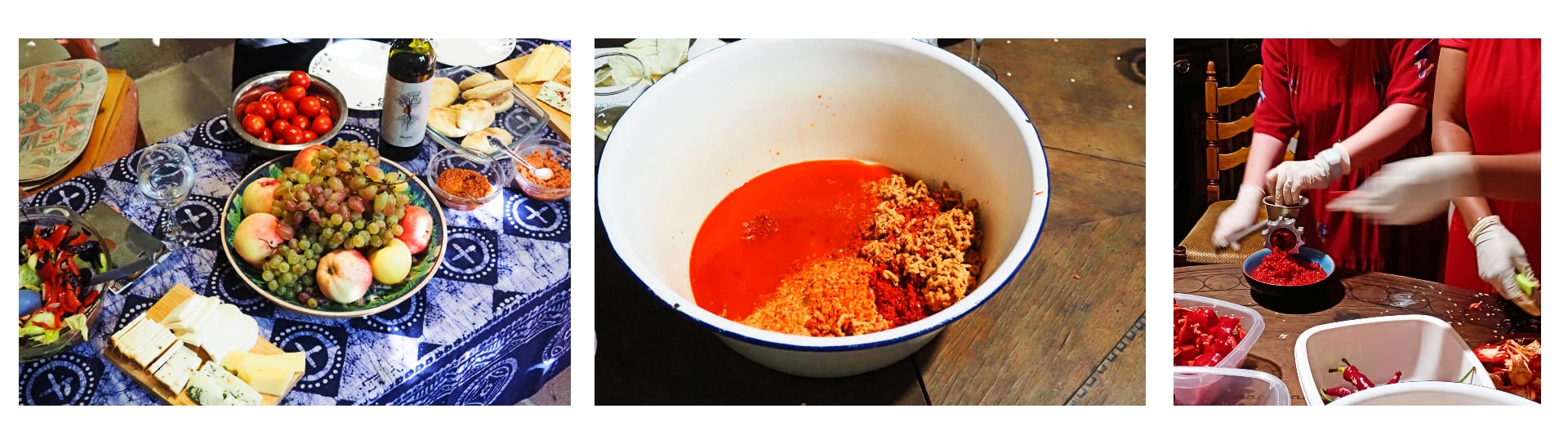
Making red pepper winter preserve Ajika as part of the food tour and Georgian-themed lunch. October, 2023
As I ponder these thoughts, I suddenly feel paralyzed. The brightly colored Georgian treats – churchkhelas and dried fruit leathers – hanging in newly opened souvenir shops contrast sharply with the informal Russian conversations of pedestrians that I hear around me, stirring existential questions I’ve tried to avoid:
How should a tour guide frame the history for Russian tourists when every moment of the past – from two centuries ago to yesterday – has been shaped by Russian imperial and Soviet forces? How do we convey this complex history while expressing the Georgian perspective on living under the influence of a larger outsider force, grappling with themes of obedience and rebellion, submission and resistance?
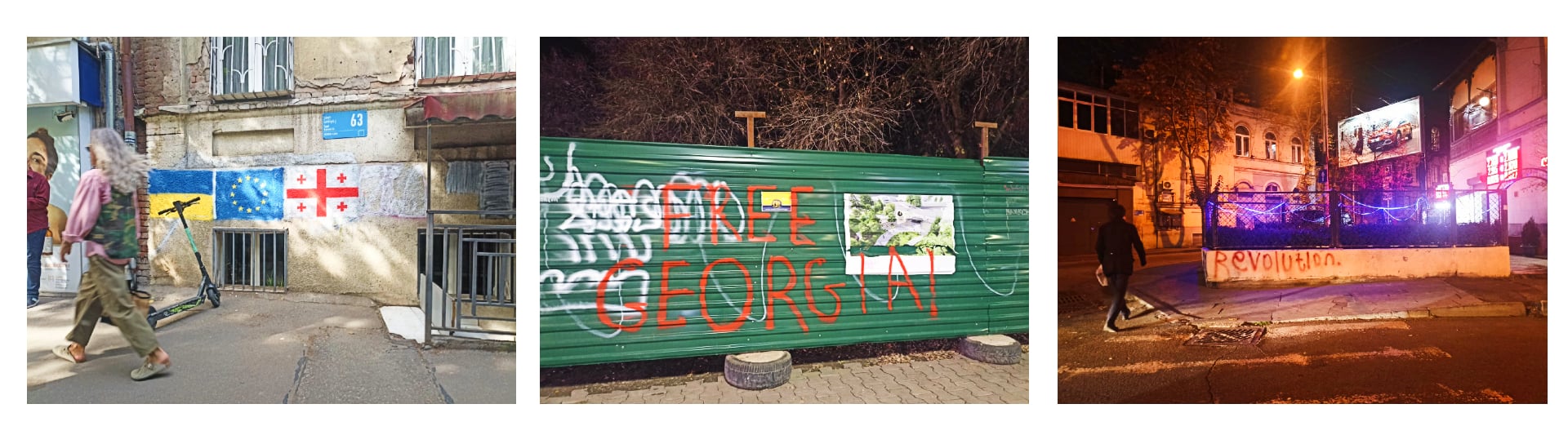
Tbilisi central streets captured by the author. Old walls and fences speak the resistance language. 2025
How normal is it to explain my version of history to representatives of a country perceived as an occupying force within my society?
How do I reconcile welcoming these people playing a role of a host society to them as my new neighbors who shift the social fabric, urban behaviors and sensescapes, not to mention economic reality in my city?
Can I normalize this cohabitation by applying the internalized mythos of Georgian hospitality to a contested reality?
…
The aroma from a nearby bakery interrupts my thoughts, soothing anxiety. I buy a loaf of Georgian bread and tear off the crunchy edge, amused again with the thought that I should be grateful I don’t have salt on hand; otherwise, it would echo the historic bread-and-salt welcoming ritual – a gesture famously offered to Tsar Alexander II of Russia by Georgian noblemen in the 1870s. Thankfully, my guests today come from a distant land, far removed from our regional political turmoil and unaware of the Caucasian tensions (with their own post-colonial challenges to solve, I suppose?). Are these grand geopolitical questions palpable in Tbilisi only to me as a local guide?
Yet it’s in my hands how to host – how to entertain, yet educate, then agitate. All over again.
Too Politicized?
Let’s begin with a legend of Tbilisi.
Take some bread, please.
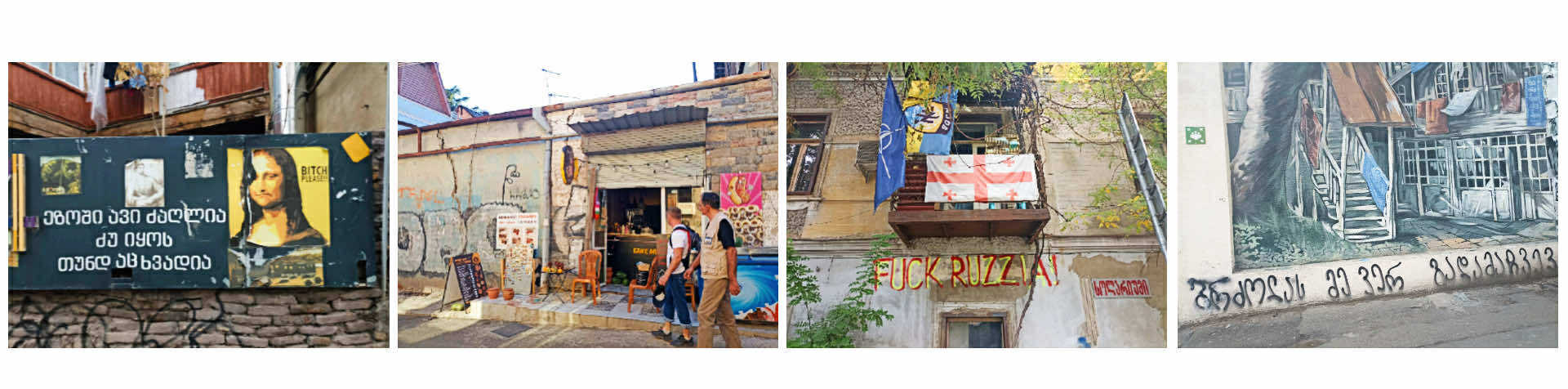
Tbilisi walls speak to me the story of hospitality, humor, resistance and determination. 2025
Tamar Babuadze is the writer and editor at the Tbilisi-based online and print publication Indigo Magazine. She is a PhD candidate at the Ilia State University. Her study areas are foodways and anthropology of senses, urban and spatial walking experiments in connection of memory, nostalgia and imagining; also migrations, borders, belonging, othering.
This text is constructed with the self-observational tool while walking and registering the essence of the surroundings. The audio recorder captured several times the stream of consciousness as a dialogue with the self while walking. The text is based on these recordings made during the several solo walks.
Babuadze, Tamar. Zaytseva, Anna: Russian Wartime Migrants’ Venues in Tbilisi: Enclave Formation and Tensions with the Host Society. (upcoming).
Gurchiani, Ketevan: Global aesthetics as an (im)perfect shelter: atmospheres of belonging and Russian migration in Tbilisi, Georgia. 2025
Ram, Harsha: The Literary Origins of the Georgian Feast: The Cosmopolitan Poetics of a National Ritual. 2014.
Manning, Paul: The Theory of the Cafe Central and the Practice of the Caf é Peripheral: Aspirational and Abject Infrastructures of Sociability on the European Periphery. 2013.
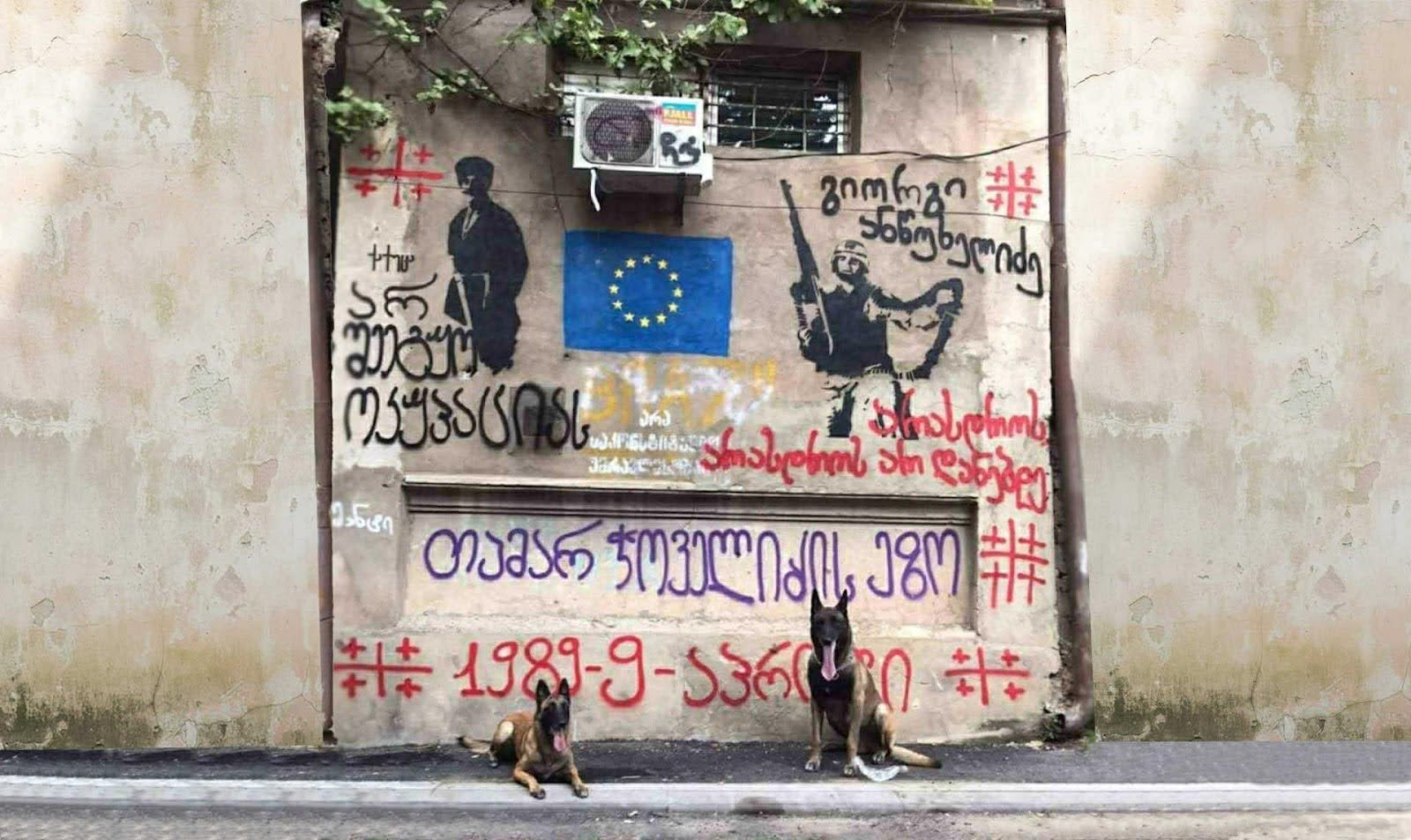
The main photo, at the beginning of the paper, is by the graffiti-artist himself who leaves these patriotic, anti-imperial messages on the walls of old Tbilisi neighborhood Vera. These cute doggies are also his. November, 2025